

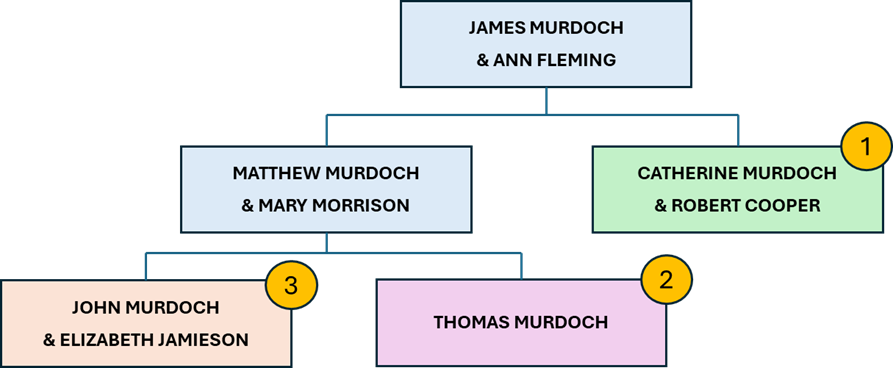
This section will look at the following three branches of the Murdoch family that settled in Australia, as well as New Zealand for a short period, namely that –
- Catherine Murdoch & Robert Cooper
- Thomas Murdoch
- John Murdoch & Elizabeth Jamieson
1: Catherine Murdoch (1823 –1903) & Robert Cooper (1823 –1916)
Catherine Murdoch, daughter of James Murdoch & Ann Fleming and Robert Cooper, son of Robert Cooper & Margaret Clark, were married at Dalmellington in July 1851. Their first child, Ann was born on 21st December 1851 and baptised on 11th January 1852. It appears that Ann died in infancy, prior to the couple starting a new life in Australia.
Robert (28) and Catherine (28) along with Mary Cooper (23), possibly a sister of Robert (although her name cannot be confirmed in the 1841 or 1851 Census Records) set sail from Liverpool on the 19th May 1853 on the “Banker’s Daughter” to Geelong, a port on the Victoria coast, south-west of Melbourne*. It is worth noting that John McGeachin (40), shoemaker journeyman, Cumnock and his wife Mary Wilson and their 8 children were also on board (two more were born in Australia).
*Public Record Victoria Australia, Assisted Passenger List (1839-1871)
EMIGRATION FROM LIVERPOOL
The number of emigrants who have left this port for Australia and America during the past month have exceeded those who have taken their departure hence in the corresponding month of any preceding year. The government emigration returns show that in the month ending, Saturday last, no less than between 27,000 and 28,000 left the Mersey for the land of the stranger. By far the greatest proportion of these have been shipped for America, which appears to have been more attractive than usual, while the passenger trade to the Australian ports have experienced a decided check owing to the unfavourable accounts received up to last week. The latest advices are, however, more cheering, and a considerable increase in the emigration to the golden land may be expected. Notwithstanding the diminution in the numbers, a noble fleet has sailed for Australia during the last few weeks; for no less than twenty-nine vessels of an aggregate tonnage of 17,476 has cleared for Melbourne, Adelaide m Geelong and Sidney. A large number of the finest packet ships in the world are now loading at our docks, and some of them will take their departure in a few days. The Banker’s Daughter went into the river on Monday, with 400 emigrants from the Government Emigration Depot at Birkenhead, and she will be followed during the month by three large ships with passengers from the same place.
Glasgow Courier Thursday 05 May 1853
Snippets of the progress of the Banker’s Daughter are given below
Shipping Intelligence
- The Banker’s Daughter left for Geelong with 384 adults, chiefly Scotch. [Liverpool Albion, Monday 13 June 1853 – a late notice]
- The ship Banker’s Daughter, from Liverpool for Geelong, 21 days, all well, June 11, lat. 7 12 N., long 21 30 W. [Liverpool Shipping Telegraph and Daily Commercial Advertiser – Thursday 21 July 1853 ]
- News from the Banker’s Daughter – The owners of the new ship Banker’s Daughter which sailed from this port with passengers from Geelong have received a most satisfactory letter from Captain Pace, date 11thJ une, lat. 7 N. long. 20, in which he states that he had been becalmed for six days, but had ran to lat. 8 in 16 days, thus proving the ship to be an extraordinary fast sailer. The emigrants, 400 in number, were all in good health and spirits. [Liverpool Standard and General Commercial Advertiser – Tuesday 26 July 1853]
- The passengers on the Banker’s Daughter disembarked at Geelong on 3rd September 1853. [Public Record Victoria Australia, Assisted Passenger List (1839-1871)]
- Cochin, March 17 – The Banker’s Daughter from Geelong to Bombay was lost on 30th December 1853 on a reef off Maldive – crew saved. [Glasgow Saturday Post – Saturday 06 May 1854]
The following year a court case brought by Baker, sailmaker against Cavan, owner which revealed some of the difficulties that the Banker’s Daughter had endured on voyage Bombay (now Mumbai).
In May 1853, the plaintiff shipped at Liverpool on board the Banker’s Daughter for Geelong it being agreed that he was to receive £4 5s per month. There were fifty hands, twenty-two of them being able seaman. They arrived at Geelong about 1st September, and on their arrival a number of the crew deserted, in fact, only one able seaman was left on board. The captain, who intended proceeding to Bombay, engaged more hands, but not sufficient for such a voyage, there being only twenty-two men, and four only of these able seamen. The pilot at first refused to take charge of the ship, and the men themselves having manifested some dissatisfaction at the ship being shorthanded, the captain offered the plaintiff, and three other men who had come in the ship from Liverpool, a present of £29 each if they would remain and help to work the ship to Bombay. The plaintiff and his companions said “they did not know what might happen on the voyage;” but the captain replied, if they chose they might have the money at once, and accordingly they went down on his invitation into the cabin and paid them the money. The rest of the crew who shipped at Geelong were paid £40 for the voyage. The vessel went to sea on the 5th November, and on or about 30th December was lost on the reef adjoining the Maldive Islands
The plaintiff’s demand for the loss of wages May to December was rejected and indeed the defendants contended there was no further liability, ‘the £20 having been forced from the captain at Geelong when the ship was in straits for want of hands’.
Catherine and Robert Cooper settled at Carlton a suburb of Melbourne, Victoria.
- Their first-born child in Australia was a daughter also named Ann (1854-55) but sadly she too passed away in infancy.
- Next, came two sons Robert (1856-1911) and James (1857-1932) followed by two daughters Margaret (1859-1948) and Catherine (1861- ).
- Three more children were born, namely Duncan Campbell (1863-1934), Janet (1866-1923) and John Alexander (1869 – 1912/15)
- [Courtesy of Ancestry: Murdoch/Wall managed by Woodfour_1, Tasmania]
As noted above Mary Cooper (c.1830) joined Robert and Catherine on the Banker’s Daughter voyage from Liverpool to Geelong and yet there is no confirmation of what relation she was to Robert. Sometime later several of his siblings also emigrated to Australia.
- James McAdam Cooper (b.1821 Straiton, Ayrshire d. 1878, New Norfolk, Tasmania )
- Elizabeth Cooper (b. 1829 Dalmellington, d. 1861 Victoria) – her marriage to William Stuart at South Yarra was announced in the Ardrossan & Saltcoats Herald, Oct 15 1859
- Alexander Cooper (b. 1832, Dalmellington d. 1916 Collingwood, Victoria; Janet Cooper (b. 1834 Dalmellington, d. 1858 South Yarra, Victoria)
- Ivie Cooper (b. 1834, Dalmellington d. 1900 South Yarra, Victoria)
- George Cooper (b. 1839 Dalmellington d. 1901 Charters Towers, Queensland).
- Although Robert’s elder brother William (b.1819 Straiton) did not emigrate to Australia his son Robert (b. 1844 Dalmellington) settled at Hexham, Victoria.
- [Courtesy of Ancestry: Murdoch/Wall managed by Woodfour_1, Tasmania]
Presumably Robert and Catherine would have contacted members of the Cooper family now settled in Victoria.
They both certainly contacted other members of the Murdoch family following the arrival of their nephew John Murdoch and his wife Elizabeth Jamieson when they emigrated to Australia in 1883/84. Indeed, Robert was called as a witness at ‘A Magisterial inquiry of behalf of our Sovereign Lady of the Queen taken at Menzies Creek’, regarding the death of John Murdoch on 30th October 1891. Robert’s testimony
Robert Cooper on his oath saith – I am a labourer and reside at Carlton – I am an Uncle of the deceased John Murdoch and have visited him at various times during the past ? years and have? now at three weeks at Mrs? ? during each visit for the past month. I have been continuously? with the Murdoch’s. I am aware he has been attended at the Melbourne Hospital for a complaint of the lungs, he informed me the Doctor’s there told him they could do him no good and have been with him to the hospital, he has been constantly attended by his wife and occasionally assisted by Mrs. Bales (or Bates), a neighbour and myself. He has had all nourishment that he could like, and every attention has been paid to him. He died on the 30th October during my temporary absence a? ?
[Courtesy of Melissa Boyack]

2: Thomas Murdoch (1857-1890)
Thomas Murdoch the son of Matthew Murdoch and Mary Morrison was born at Auchreoch, Balmaclellan, Kirkcudbrightshire.By the time of the 1881 Census, Thomas was working as a railway porter while lodging with his Aunt Barbara Clark (nee Murdoch) and her husband Quintin Clark, railway gatekeeper at the Gatehouse, Dalmellington, Ayrshire.
Current research has yet to reveal what year, between 1881-1890 inclusive, Thomas Murdoch set sail for a new life in Queensland, Australia.

Sadly, the only information unearthed about Thomas Murdoch is the following newspaper report in the Ayr Observer, Friday 27 June 1890, relaying the original article in the Roma Star.
DEATH OF A NATIVE IN QUEENSLAND. – We extract the following from the Roma Star, Queensland, of April 19TH 1890.
“A man named Thomas Murdoch, aged 33 years, a native of Scotland died in the hospital on Thursday, 17th April, at 6 a.m. He had been an inmate of the institution for about three months, suffering from consumption. The late Mr Murdoch had for some years past resided at Yeullea*, having been employed at the Railway Station of that township. He was a member of the Maranoa Lodge of Freemasons, and the brethren of that Lodge complied with the request of the deceased to have the funeral conducted to Mason rites. The members of the Raphael Lodge E.C., also kindly joined in these last sad ceremonies. The funeral took place on Thursday evening, and was viewed by many sympathetic spectators along the line of the route. Mr Murdoch had no relations in Queensland. Those who knew him speak highly of him as an upright man, and as a good Freemason”
Deceased was a native of Balmaclellan and was for upwards of seven years porter at the Dalmellington Station of the Glasgow and South Western Coy.
Ayr Observer, Friday 27 June 1890
Of particular interest, is that Thomas having worked as a railway porter at Dalmellington now found work at a railway station in Australia, in this case Yuleba some 260 miles west of Brisbane. There may well have been a demand at that time for railway jobs and as such Thomas met the criteria for Assisted Passage on ships from Glasgow, i.e. at a lower cost or even free charge. The other note of interest is ‘Mr Murdoch had no relations in Queensland’ and so it seems the brief period that John Murdoch and his family lived at Brisbane, the two brothers did not meet.
*Yeulla should read Yuleba, a rural township in the Maranoa Region, south-west Queensland. The original Railway Station had one platform and was opened in 1879. Yuleba was incorrectly spelled in the original station by the railway carpenter assembling the wooden letter on the nameboard as Y E U L B A. The Geographical Names Board had the name corrected in 1938. A new station was built, and the original station was donated to Drayton, 230 miles away.


3: John Murdoch (1852-1891) and Elizabeth Jamieson (1854-1941)
John Murdoch was one of the elder brothers of Thomas Murdoch and the son of Matthew Murdoch and Mary Morrison born at Auchreoch, Balmaclellan, Kirkcudbrightshire. By the 1881 Census he was living at 7 Main Street Dalmellington with his wife Elizabeth Jamieson and their three children, all born at Dalmellington – Elizabeth, Mary and Matthew while a fourth, Barbara was born there in December 1882.
At the time John was working as contractor & carter.
AYR SMALL DEBT COURT – In this court yesterday, Mr John Murdoch, carting contractor, Dalmellington, sued William Aitken, residing at Dunasken, for damages, modified to £12, for having slandered the pursuer by stating falsely, maliciously, and calumniously, on 28th February last, at Dalmellington Railway Station, in presence of the stationmaster and others, that the pursuer, who has a contract for carting wood to the Dalmellington Iron Work, for which he is paid by weight ascertained at the weighing machine at the railway station, had been “swindling the Dalmellington Iron Company all along, and that he (the defender) had found him out and could prove it,” by which the pursuer had suffered greatly in his feelings and character, and his business, and reputation as a contractor had been greatly injured. The case was postponed to the end of the roll for proof, but the defender having in the interval withdrawn the imputation, and apologised for having made it, the case was withdrawn, defender paying the expenses. The apology is in these terms:-
Ayrshire Post, Friday 16th March 1883
“Ayr, 15th March, 1883 – Mr John Murdoch Dalmellington. – In regard to the action by you against me for defamation, I have to say that I do not charge you with swindling, and have no ground for doing so; and if I used any language implying that I did make such a charge, or anything like it, I regret doing so, and most willingly withdraw it. – I am, your obedient servant (signed), William Aitken”
A quick look at the 1881 Census revealed William Aitken as a spirit merchant living at 1 High Main Street, just across the road from the Murdoch household at 7 Main Street.

It may have been after this incident that John Murdoch thought about starting a new life away from Dalmellington. In any case Just over a year later John & Elizabeth Murdoch along with their four Dalmellington-born children – Elizabeth (6), Mary (5), Matthew (4) and Barbara (1) – were setting sail from Glasgow to Brisbane, Australia on the S.S. Crown of Arragon.
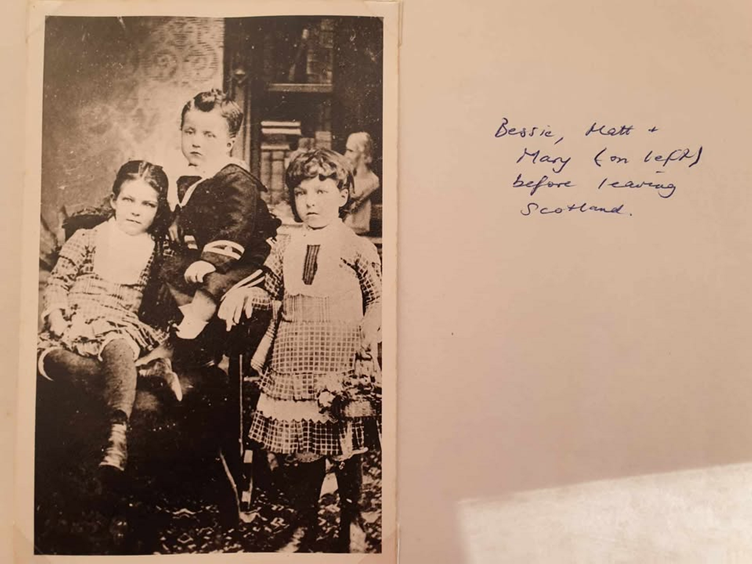
The Crown of Arragon, a splendid iron screw-steamer, had been launched by Messrs. Scott & Co., shipbuilder, Cartsdyke, Greenock on 16th October 1883. She had been built to the order of Messrs. Prentice & Clapperton, shipowners, Glasgow and she was named at the launch by Miss Prentice, daughter of the owners. The ship made the headlines a month later on 19th November when leaving from Glasgow, outward bound for Bombay, via Liverpool it collided with the screw-steamer Blaenavon of Cardiff, as it was leaving the wharf at Bowling and crossing the River Clyde. The Welsh steamer quickly sunk and its crew rescued by those of the Crown of Aaragon [Glasgow Evening Times 20th Nov 1883}. The ensuing court case found the pilots of both ships guilty of the collision [Glasgow Herald 11th December 1883]. The damage to the Crown of Arragon was quickly repaired and the ship docked at Bombay in early January 1884, by which time it was owned by the Henderson Brothers

Later newspaper advertisements would specify the terms for Assisted Passages and for those not eligible.
ASSISTED PASSAGES will be granted to eligible persons, such as Engineers, Farmers, Farm Labourers, Engine Drivers, Blacksmiths, Bricklayers, Masons, Carpenters, Joiners, Miners, Quarrymen, Navvies, Domestic Servants and others approved, for £7 per Adult. Persons not eligible for Assisted Passages will be taken at £17 per Adult. Children under 12 years, Half Fare; Infants Free. The special attention of Shippers and Passengers is called to this excellent opportunity of direct communication by Steamer from Glasgow.
The Glasgow Weekly Herald, 1st March 1884
The Murdoch family fell into the category of ‘Persons not eligible for Assisted Passages’ and in this case commonly known as Steerage, the lowest possible category of passenger accommodation in long distance steamer travel. This reflected the financial difficulties that the Murdoch family endured at the time, in some case Steerage passengers would have to provide their own bedding and even food. Accommodation was below deck and typically in cramped conditions and little room for fresh air. To add to their plight Elizabeth Murdoch was expecting a fifth child, possibly 2-3 months pregnant.

The ‘Shipping Intelligence’ of the Crown of Arragon’s journey from Glasgow to Brisbane confirmed its departure from Glasgow on 17th April 1884 and arrival at Maderia on 24th April, Capetown on 20th May and then on June 25th ‘at the Bar’, the entrance to the Brisbane River.

The Brisbane Courier not only reports the arrival of the Crown of Arragon ‘at the Bar’ on June 25, it also fortuitously lists the name of the twenty-five Steerage Passengers –
Elizabeth McNab, Margaret Anderson, Agnes Anderson, Elizabeth Airth, Ann Neil, Ellen Daly, Albert E Spark, Thomas Kirkton, William Plenderleith, William Hearon, George Peggie, George Brownlie, George R Brownlie, James Brownlie, Dugald Tait, Peter Eider, Walter Ross, John Davidson, Annie Davidson, JOHN MURDOCH, ELIZABETH MURDOCH, ELIZ. J. MURDOCH, MARY MURDOCH, MATTHEW MURDOCH, BARBARA MURDOCH, and 383 assisted passengers in the proportions of 39 single women, 196 single men, and 148 married. [The Brisbane Courier, Thursday 26 June 1884]
The Brisbane Courier, Thursday 26 June 1884
However, the final leg of the journey to Brisbane was put on hold –
‘The steamer Crown of Arragon had scarlet fever of a virulent type aboard and had been placed in quarantine. Altogether there had been twenty-fours cases, six of which had proved fatal.’
Colonies and India, 15 Aug 1884.
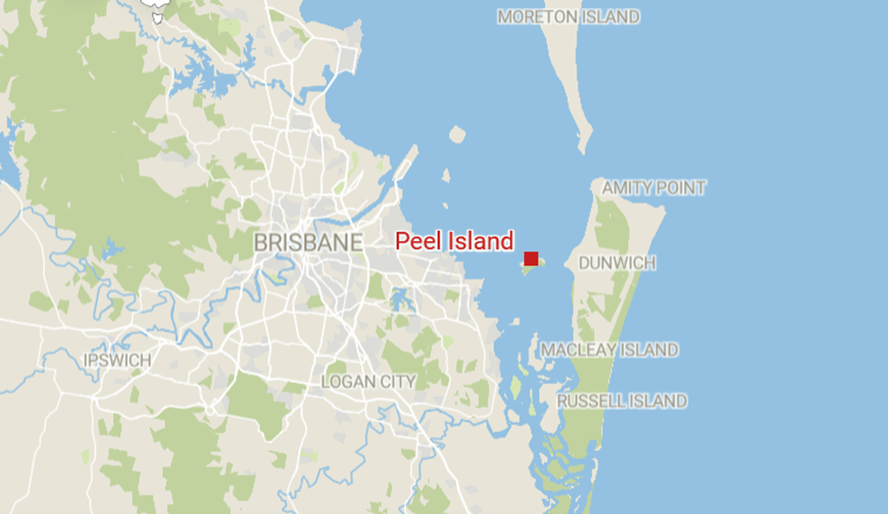
The quarantine station was based at Peel Island in Moreton Bay isolated enough to provide a buffer between arriving ships and the colony of Brisbane.
A passenger sent the following report to The Telegraph newspaper –
The Crown of Aragon left Glasgow on April 18th with 458 passengers and experienced fine weather in the run to Maderia, where she arrived on April 27. About this time scarlet fever broke out and continued its devastating course despite all isolation of the patients and fumigation. Seven deaths have taken place during the voyage six from scarlet fever and one from inflammation of the brain. Apart from the epidemic the general health of the passengers has been excellent. On all side before leaving Glasgow, it was conceded that the passengers were the finest in appearance that had ever left the Clyde. It may be mentioned that the amount of money placed by them to draw upon their arrival in Queensland is the largest sum ever known to be deposited by a similar, or even a larger, number of emigrants. Dr. J. E. Usher is the surgeon superintendent, to whom was handed a testimonial on June 24, by a committee representing the whole of the passengers. Mrs. Knight is the matron. The steamer also called at Cape Town.
The Telegraph, Sat 28 Jun 1884
Isabella Murdoch
Following the required period of quarantine the Crown of Aragon, ‘Entered Inwards, July 15’ – presumably into the Brisbane River to dock. [The Brisbane Courier Wed 16 Jul 1884].
The Murdoch family settled at Brisbane and on 29th October 1884, a daughter Isabella Murdoch was born, but sadly she died a few weeks later on 16th November 1884.
Annie Murdoch
The family history account notes that the family were keen to move to a cooler climate ‘John and Elizabeth left Queensland for New Zealand and Elizabeth was sick for most of the journey as she was pregnant with Annie, who was born on the 29th of April, 1886in Mosgiel, Dunedin.
Mosgiel, Dunedin takes its name from Mossgiel farm in the parish of Mauchline, Ayrshire (about 14 miles north of Dalmellington) the birthplace of the Rev. Thomas Burns, one of the Dunedin founders. He was the son of Gilbert Burns and the nephew of Scotland’s national bard, Rabbie Burns; both brothers farmed Mossgiel for a period.

Margaret Murdoch and John Murdoch
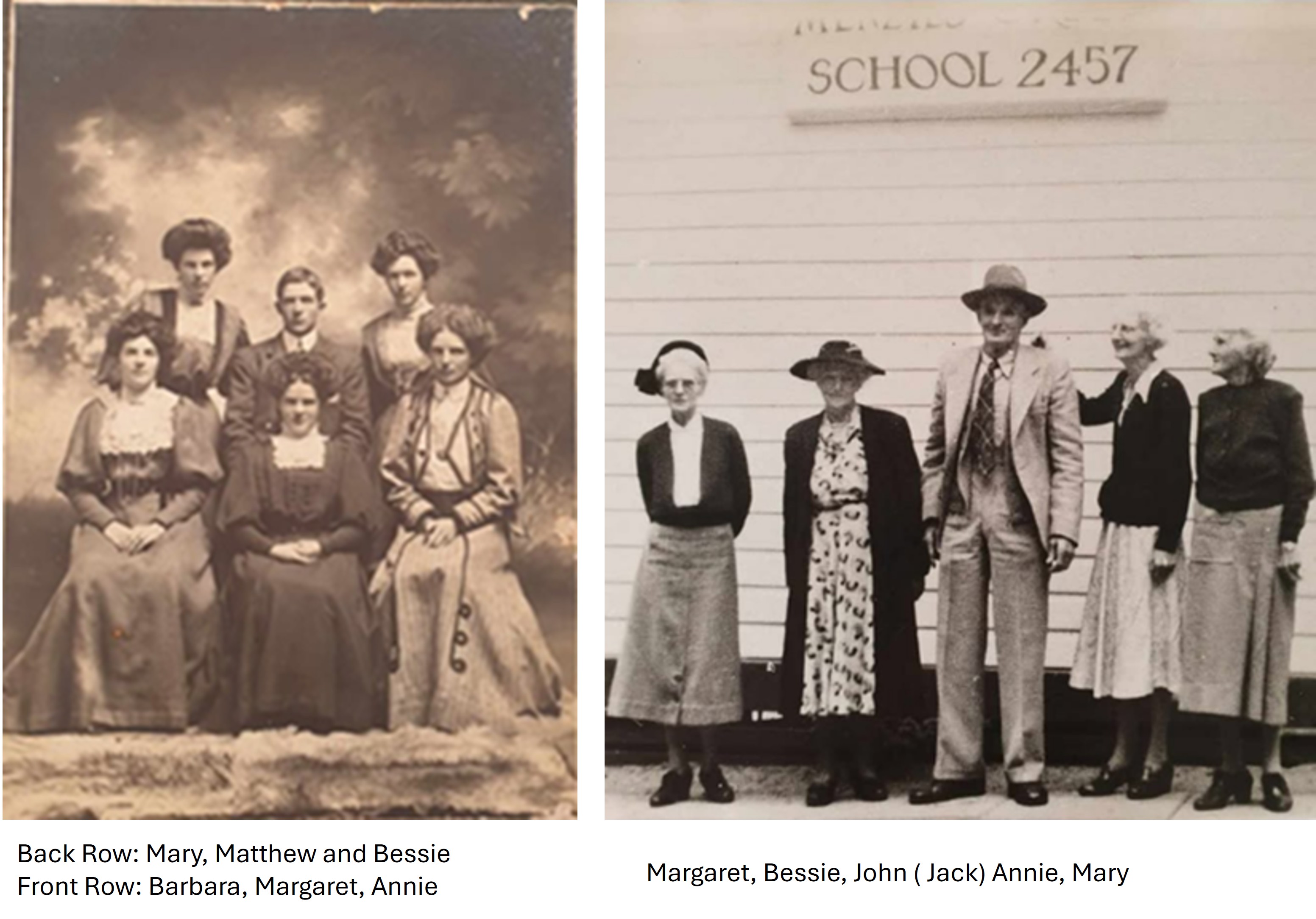
When Annie was about 18 months old the Murdoch family moved back to Australia to settle at Menzies Creek, some 25 miles to the east of the city of Melbourne, Victoria. A daughter Margaret was born there on 22nd November 1887 and few years later a son John, also known as Jack, was born on 26th August 1890; the last of the children.
Sadly John Murdoch senior passed away soon after.The family account reads John and Elizabeth bought a small farm/some land at Menzies Creek. To keep the family fed and clothed, John went to work on the railway line, often working in water up to his knees. It proved too much for him, on 30th Oct, 1891 he died of tuberculosis of the lungs at the age of 40 years.
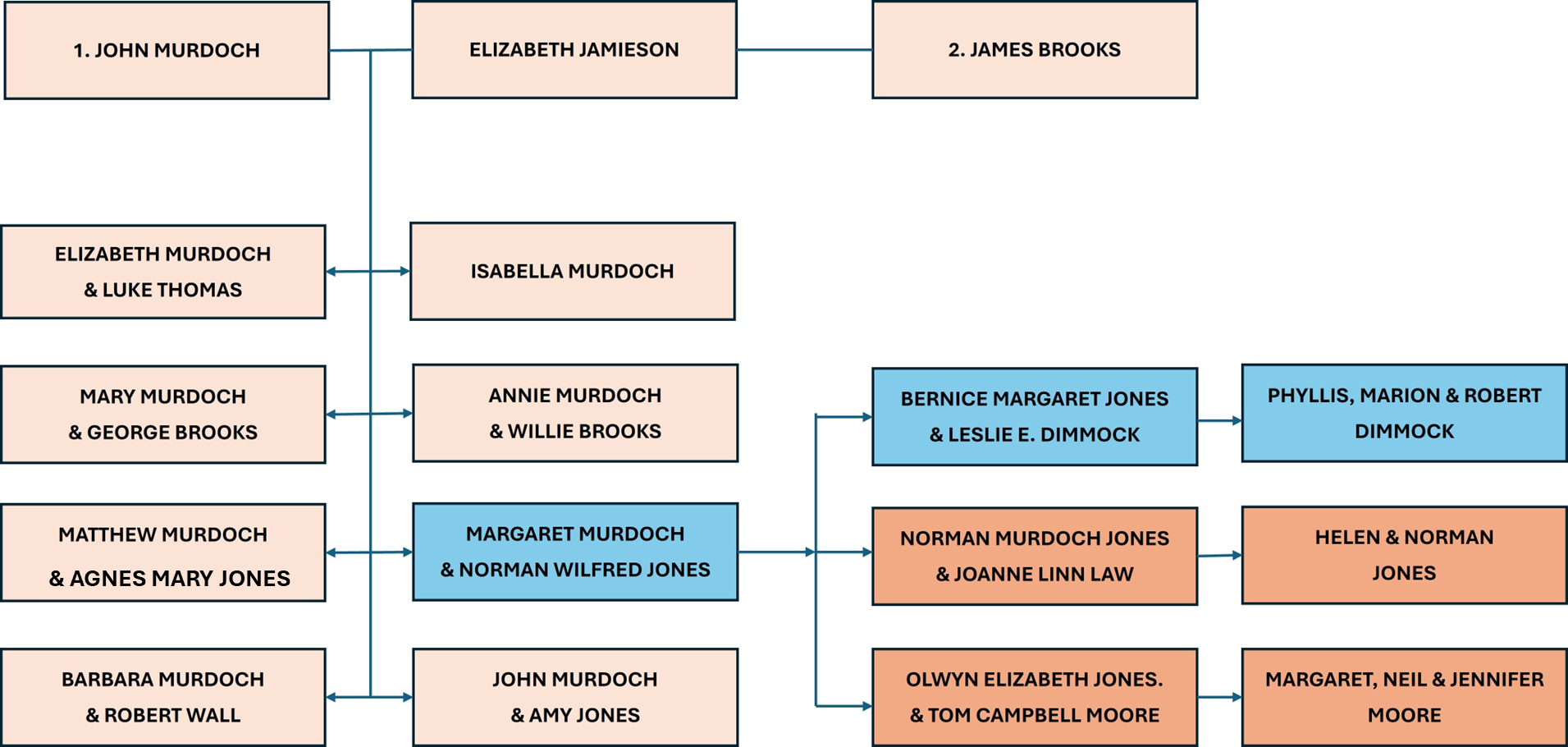
The passing of John Murdoch is a major milestone in the history of ‘the Murdoch family of the Estate of Waterhead, parish of New Cumnock, Ayrshire’. He was the son of New Cumnock-born Matthew Murdoch and Mary Morrison, born in Balmaclellan, Kirkcudbrightshire and married Elizabeth Jamieson, born in Maybole, Ayrshire. The couple settled in Dalmellington, Ayrshire where their first four children were born Elizabeth, Mary, Matthew and Barbara and then set sail from Glasgow in April 1884 to Brisbane, Australia. Four more children were born Isabella (Brisbane), Annie (Mosgiel, New Zealand) and Margaret and John ‘Jack’ (Menzies Creek, Australia).

Phylls Parish (nee) Dimmock & Mellisa Boyack
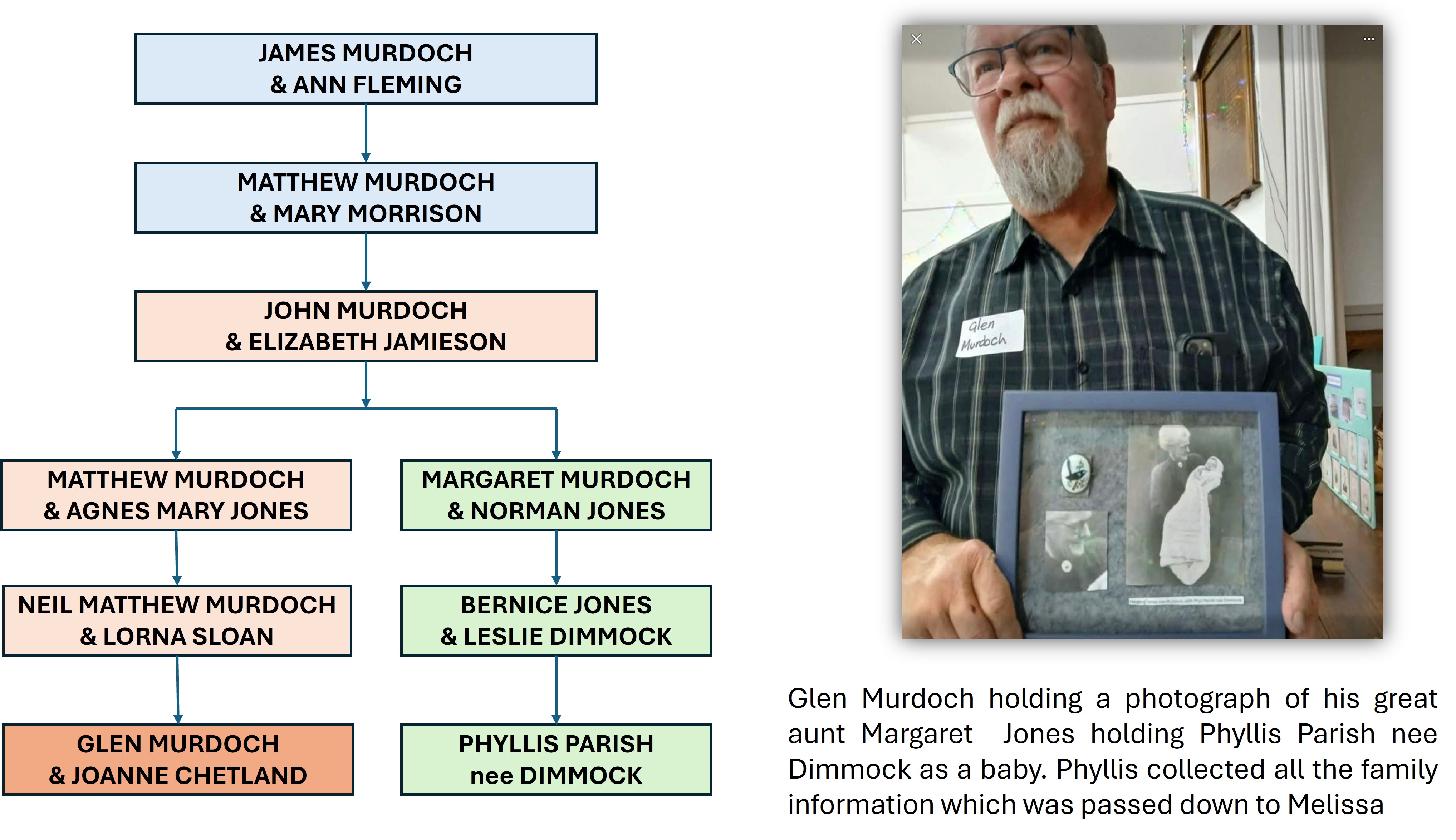
In recognition of Phylls Parish’s tireless research into her family history it is only right to position her place in the Murdoch family tree. Phyllis was as the daughter of Leslie Dimmock & Bernice Jones; the granddaughter of Margaret Murdoch & Norman Jones; great-granddaughter of John Murdoch and Elizabeth Jamieson and the great-great granddaughter of New Cumnock born Matthew Murdoch & Mary Morrison and beyond.
Of course, Phyllis is also the aunt of Melissa Boyack who continues to promote her aunt’s research as well as broadening and expanding the family tree.
UPDATE FEBRUARY 2026
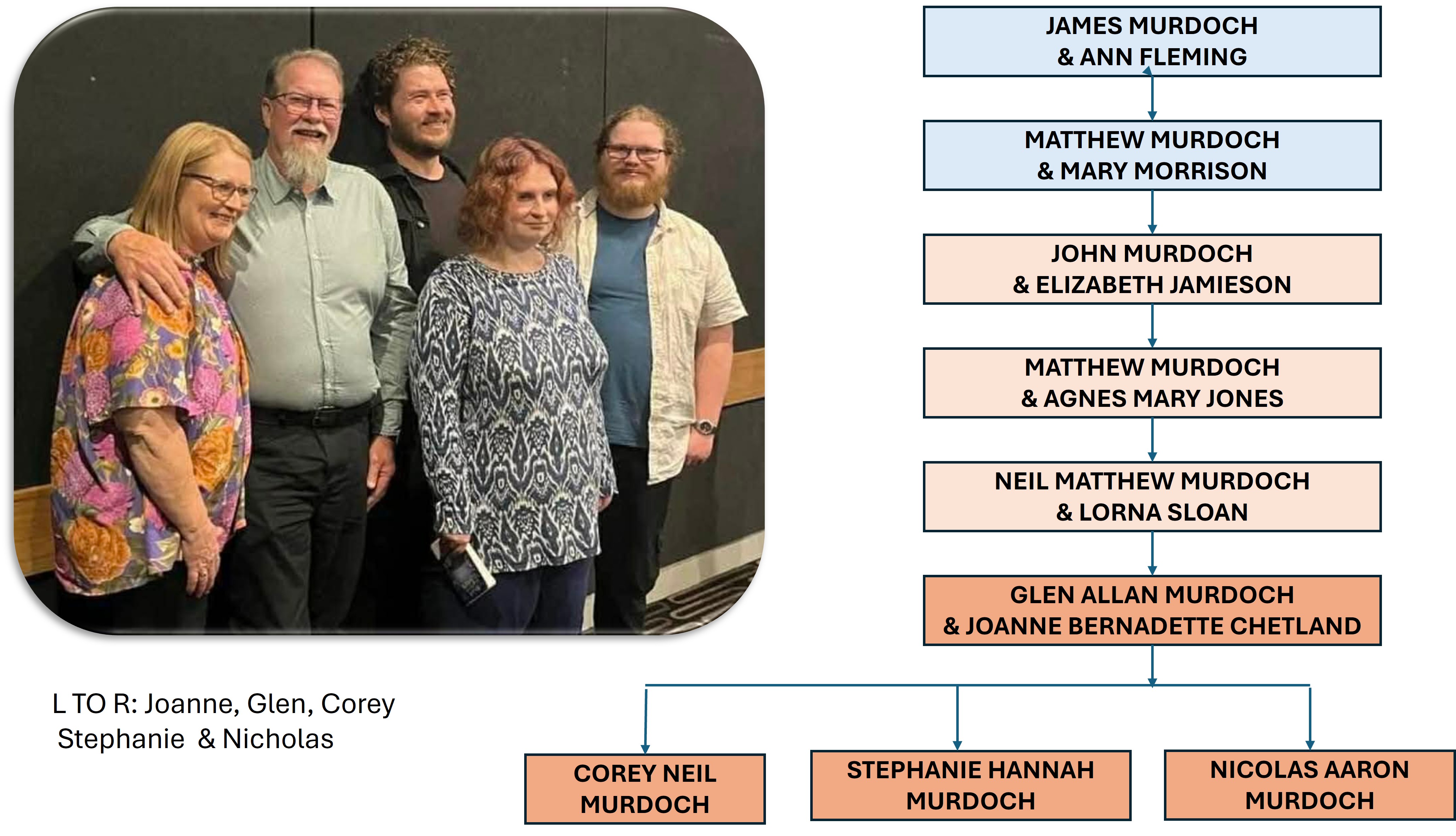
Melissa informed me that she had held a successful ‘Jones Reunion’. Attending was Glen Murdoch and members of his family one of the few who still have the surname Murdoch. Glen kindly got in touch and shared the following photographs
Glen and family members
Glen with a framed photo of great aunt Margaret Jones holding baby Phyllis
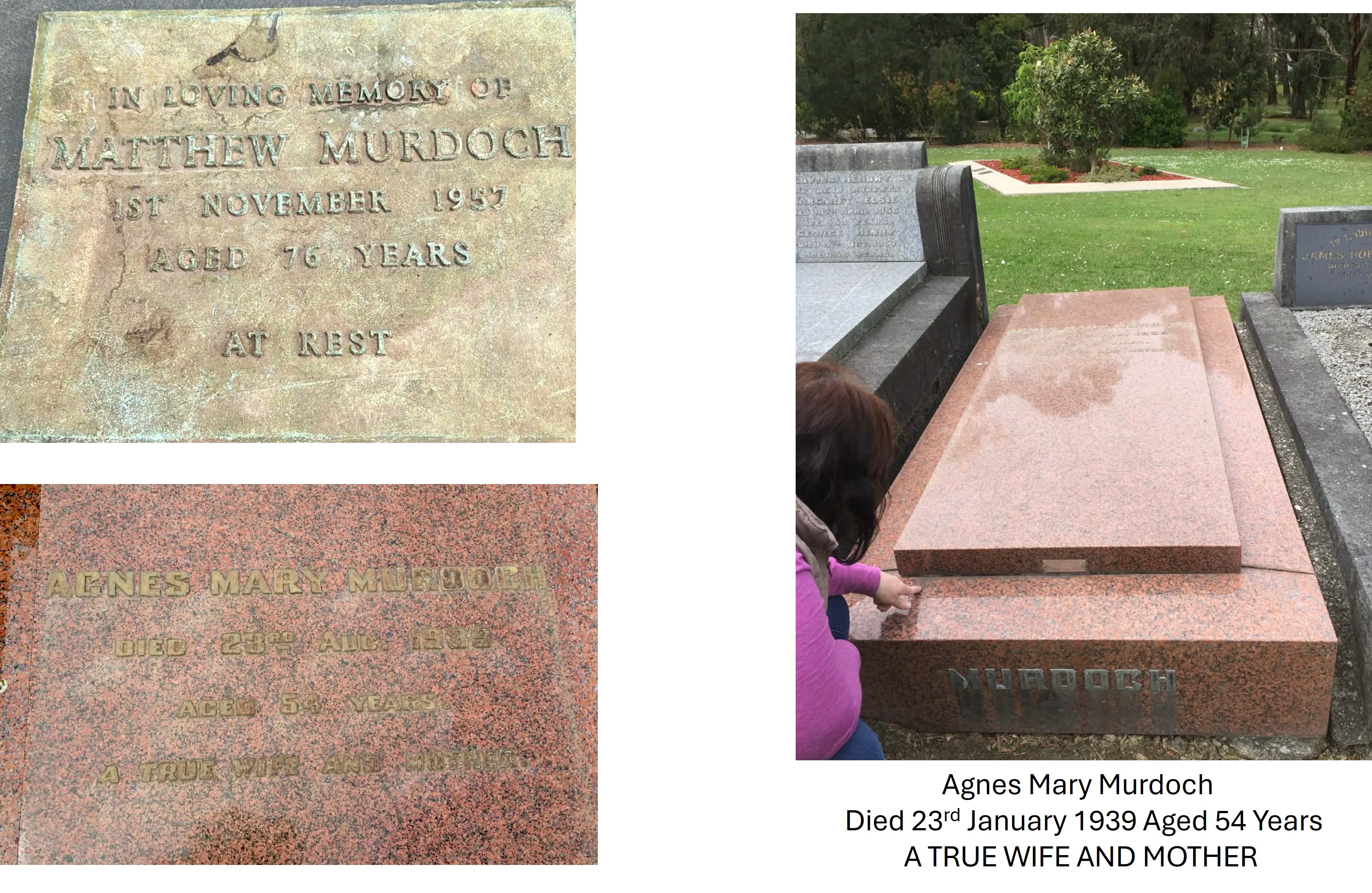
Tombstones of Glen’s grandparents Matthew Murdoch and Agnes Mary Jones
Children of James Murdoch and Ann Fleming & their Spouses
New Cumnock Auld Kirk & Kirkyard and other Churches
Robert Guthrie September, 2025
New Cumnock History & Heritage
