
The whereabouts of John Murdoch, the eldest son of James Murdoch and Ann Fleming, has yet to be found in the Census Records of 1841.
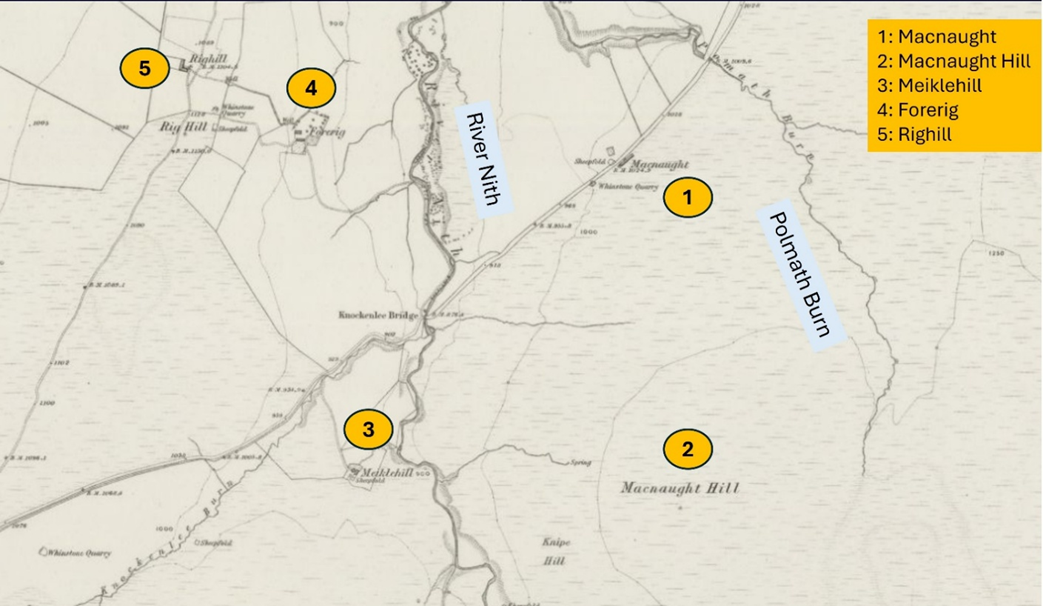
Rigg – division Fore-Rigg, New Cumnock, Ayrshire
The 1851 Census has John Murdoch (35) lodger and carter, living at Rigg along with his younger brother Matthew and his family. Matthew had taken up the Three-Year tenancy of the Fore-Rigg division of the lands of Rigg at Whitsunday 1851, namely 15th May. However, Matthew decided not to see out the Three-Year tenancy and by 1852 he and his family had relocated to Auchreoch, Balmaclellan, Kirkcudbrightshire.
Meanwhile on 9th November 1852*, John Murdoch married Elizabeth Kerr, probably the ‘Elizabeth born the 8th January 1830 N.D. (natural daughter) of James Kerr and Sarah Park, the Mother above? and Sponsor’. (*N.B. the date of marriage is found in the birth record of their children).
It appears that John Murdoch may have taken up the tenancy of Fore-Rigg as witnessed by the Valuation Rolls of 1855 which identifies the tenants of Fore-Rigg as Messrs Murdoch – i.e. presumably brothers Matthew and John, suggesting a partnership. As such it also suggests that Elizabeth Murdoch was born at Fore-Rigg.
Macnaught (Maneight), New Cumnock, Ayrshire
In September 1854 the Estate of Waterhead listed a number of farms on the estate to be let for the period of 15 years, including Fore-Rigg, with the entry to the House, Meadows and Pastures on Whitsunday 1855 (15th May). However, although John Murdoch did not continue the tenancy of Fore-Rigg, he did take that of Maneight (also known as Macnaught), the lands of which are described as –
2. MANEIGHT, a desirable mixed Farm, consisting of about 80 acres of very improvable Arable Land, of which a large portion has been lately drained; about 20 acres of Meadow and good hill pasture -partly heathy and partly green – extending to 930 acres, or thereby, capable of rearing good Sheep, Dairy Stock and Young Cattle

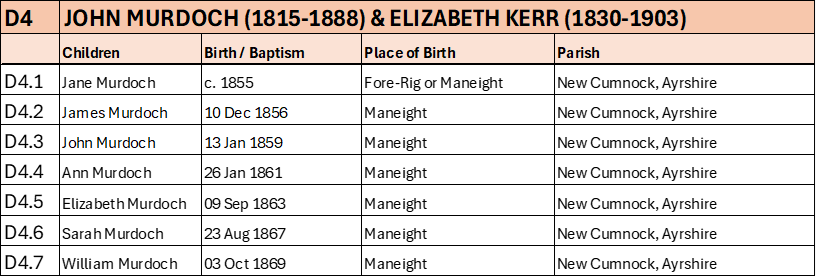
By the time of 1861 Census, John Murdoch, dairyman, his wifeElizabeth Murdoch were settled at Maneight along with their four children. Elizabeth, the eldest was born in 1855 (no baptism/birth-date record) and it is not clear if she was born at either Fore-Rig or Maneight. The other children James (b.1856), John (b.1859) and Ann (b.1861) were all born at Maneight.
Also living at Maneight at that time was John Murdoch’s 61-year-old widowed father James Murdoch. He passed away three years later 11th July 1864, aged 84 years and was laid to rest in the Auld Kirkyard, New Cumnock alongside his wife late Ann Fleming.
Prior to the 1871 Census, three other children were at Maneight -Elizabeth (b.1863), Sarah (b.1867) and William (b.1869)

In March 1870 the Estate of Waterhead had extended the time for receiving offers for letting several of their properties, namely Meiklehill, Maneight, Little Riggend and the Limestone Quarry & Land for a period of 15 years. The condition associated with Meikehill and Maneight was either let together or separately. The description of Maneight given was –
2. MANEIGHT, extending to about 1030 Imperial Acres, or thereby, including a valuable Meadow, and some extent of Arable Land, suitable for Dairy Stock, the remainder being sound Sheep Pasture

Little Riggend, New Cumnock, Ayrshire
Although John Murdoch opted to leave Maneight, he secured the lease for Little Riggend, in early 1870, as described below-
3. LITTLE RIGGEND, containing about 316 Imperial Acres or thereby, consisting of good Pasture, Meadow and Arable Land affording scope for Dairy Husbandry, and the Rearing of Cattle or Sheep.

Waterhead Castle is often referred to as a baronial Castle for Cathcart, however it was the seat of the baronial manager. N.B. It is also found in CANMORE as Little Rigend Castle, probably because Little Rigend was nearby. However, it has never been known by that name locally.
In preparation for making the move from Maneight, the traditional ‘Day’s Ploughing’, also known as ‘Friendly Ploughing’ or ‘Love Darg’, from Scots darg ‘a day’s work’, descended on the lands of Little Riggend on 26th March 1870. The event made the local newspaper of the time –
DAY’S PLOUGHING: Mr. John Murdoch, having entered on a lease of the farm of Little Riggend, his numerous friends and acquaintances turned out on Saturday last to give him the customary’s day ploughing. At an early hour of the day 24 well mounted ‘teams’ appeared on the ground. Though the severe frost of the preceding days rendered the work somewhat difficult, yet each man succeeded in completing his lot, in a highly creditably manner. Both ploughmen and onlookers were abundantly supplied with creature comforts. We heartily wish Mr. Murdoch great success in his new undertakings.
Ardrossan and Saltcoats Herald, April 2, 1870
Sadly, shortly before the Murdoch family entered the Little Riggend, young Sarah Murdoch, aged 2, died at Maneight on 3rd May 1870, and was laid to rest in the family lair at the Auld Kirkyard.
The 1871 Census referred to the farm as Low Riggend and recorded that all remaining members of the family were living- John, farmer of 317 acres of arable land, employing 1 man, his wifeElizabeth and their children Jean, James, John, Ann, Elizabeth and William.
Tragically, scarlet fever struck the family taking Jane, 22 years, in 1876 while living (probably working) at Lugar Street, Cumnock and then William, 5 years, in 1877 at Little Riggend.
In 1880 an interesting article appeared in one of the Ayrshire newspapers of the time regarding impressive turnips being grown by John Murdoch at Little Riggend –
DALMELLINGTON There may be now seen, in the shop window of Mr James Murdoch, grocer, here a turnip 16 ½ lbs weight, which measures in girth one way 35 inches and the other 36 inches. This turnip grew on the farm of Riggend which is nearest the highest point of the road betwixt Dalmellington and New Cumnock, and which must be 800 or 900 feet above sea level, and near to Ben Beoch hill, where a cave is, which 200 years ago was like a city of refuge for the Covenanters*. Had the farmers in those days been able to raise such turnips as Mr John Murdoch does now, these poor fugitives might have had worse fare than one of these, as doubtless they many times had.
The Irvine and Fullarton Times, October 16, 1880.
James Murdoch, grocer on the Main Street, Dalmellington happened to be John Murdoch’s nephew, born at Fore-Rigg, New Cumnock, the son of Matthew Murdoch and Mary Morrison.
*The Covenanters took their name from those that signed (or supported) the National Covenant in 1638, in opposition to the Scots born king Charles I and his meddling in the affairs of the Presbyterian Church of Scotland. In 1660, following the Restoration of his son Charles II, the persecution of Covenanters intensified, forcing many to take refuge in the hillsides. There are many Covenanter graves and memorials in south-west Scotland as a consequence of ‘The Killing Times’.
The 1881 Census reflected the recent family which now numbered John Murdoch (65) & Elizabeth Murdoch (61) along with James (24), John (22), Ann (20) and Elizabeth (17) at Little Riggend farm.
John Murdoch’s 15 year let of Little Riggend had come and gone and clearly this had been extended, since it was Little Riggend on 24th January 1888, that he passed away.
NEW CUMNOCK – IN MEMORIAM – Our obituary column today records the death of Mr John Murdoch farmer, Riggend, who passed away to the spirit-land on Tuesday last at the age of seventy-two. Until a few months ago, when it began to be quite apparent that his health was beginning to fall and his strong frame to give way, no one would have believed that he had much passed the three-score. The greater part of his life was passed in this parish, and high among the hills which lie around the springs of the Nith. Among the rural dwellers there he was held in the highest respect, and when on market days he came down from his upland abode to the town of Old Cumnock, he was one of the most conspicuous among all the farmer tribe there, as, with tall figures and herculean frame he moved with leisurely step through the streets. Of genial manners, equable temper, and a quiet pleasant wit, he was an agreeable companion, a good neighbour, and a plodding, industrious farmer. A Conservative in politics, he could not understand, and greatly disliked, the rash and the reckless legislation which has so many advocates among the advanced and speculative politicians of these recent times. In religious matters he was quiet and unobtrusive, liking best the good “old paths” yet unwilling to meddle with other men’s views and opinions. Peace be to his ashes! They are having their countenances changed,” and are being “sent away,” these old familiar faces ! for time flies and urges the generations of men ever onward to the unseen world; and when we think how the whole upper valley of the Nith has changed nearly its whole inhabitants, within the writer’s own recollection, we cannot help uttering the wall of the author of The Night Thoughts regarding the uncertainty of the life of man – “Poor pensioner on the bounties of an hour.”
Ayr Advertiser, 27th January 1888
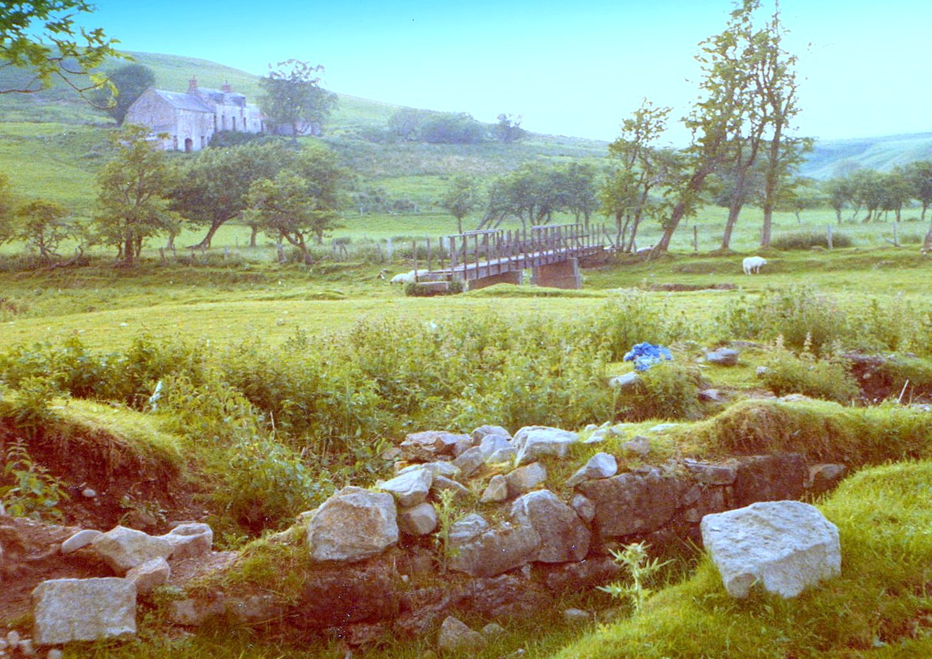
The photograph above was taken in the late 1970s when I was member of a group from the New Cumnock Local & Natural History that were ‘excavating’ the ruins of Waterhead Castle. The farm was abandoned at that time. In 1994 a Desk-bound survey was commissioned by the landowners of a proposed opencast site. Soon after, extensive opencast coal activity was carried out around this upper stretch of the River Nith. Nothing now remains of Little Rigend farmhouse.
In 1889 Elizabeth Murdoch hosted the Cumnock Free Church Sunday School trip the country –
On the morning of Monday least children attending the Sunday School of the Free Church here, along with their teachers and a number of their parents had their annual excursion to the country. Seated in a large number of carts provided by the farmers and other and the large brake of Mr Murray of the Dumfries Hotel , they left, and went by way of Glaisnock Road, past the beautiful house and policies of Glaisnock (Captain Campbell’s), then onto Benstone Smithy, where they turned off the high road, passing Wellhill, Fardenreoch , and Dalgig, then onto Waterhead not far from the source of the Nith, where they had to leave their conveyances, and travel up the hill to Riggend , the residence of Mrs Murdoch and family, where they were all kindly received and treated. The youngsters on their arrival in a field above the house sat down and partook of buns and milk, while the teachers and others partook of curds and cream, and afterwards of tea. The day was fine, the crops all along the way looked beautiful, several of the farmers were commenced cutting their hay, which appeared to a very heavy crop. Corn and potatoes also looked well. In the field several hymns were sung by the children, led by Mrs Hodge, the leader of the psalmody. Afterwards they engaged themselves in racing, football, swinging, and other games, till after four o’clock, when they had another refreshment of buns, pies, milk, &c. The day was lovely, the hills and dales were beautiful, the air was most bracing, and the sheering of sheep, which was going on at a little distance, with the gathering of wildflowers by many of the youngsters, made both old and young happy and joyful. Before leaving the ground, the Rev. Mr Warrick, in a few words proposed a very hearty vote of thanks to Mrs Murdoch and family for the great kindness shown by them, which was responded to most heartily. They afterwards proceeded down the hill to where they had left their conveyances.
Ayr Observer, Friday 5th July 1889
In the 1891 Census, Elizabeth Murdoch now takes on the title of farmer with her four unmarried children still living at Little Riggend. By the 1901 Census eldest son James Murdoch (44) is recognised as the farmer at Low Riggend (i.e Little Riggend), while Elizabeth (71) although head of the family, is referred to as a farmer’s mother. His three siblings John (42), Ann (40) and Elizabeth (37) all work at the farm or farmhouse.
On 10th February Elizabeth Kerr (nee Murdoch) passed away at Little Riggend, aged 73 years and was laid to rest with her husband in the Auld Kirkyard, New Cumnock.
The four siblings continued to farm at Low Riggend with James and John as farmers while Annie took charge of the dairy work and Elizabeth, as a general servant or housekeeper.
On the 5th August 1918, John Murdoch 58 years, passed away and three years later his sister Annie Murdoch, 59 years died on 1st August 1921; both at Little Riggend. James and Elizabeth Murdoch, continued to live and work as joint farmers at Little Rigend and as tenants until 1930, earmarking some 60 years at Little Rigend.
James and Elizabeth Murdoch both retired from farming and settled together at Grimmet Cottage some 2 miles west of Dalmellington town. The siblings passed away some 3 months apart at Ayr County Hospital, Elizabeth, aged 72 years and James, aged 79 years.

The Murdoch dynasty on the lands of the Estate of Waterhead had come to a close.
Children of James Murdoch and Ann Fleming & their Spouses
 NEW CUMNOCK HERITAGE